

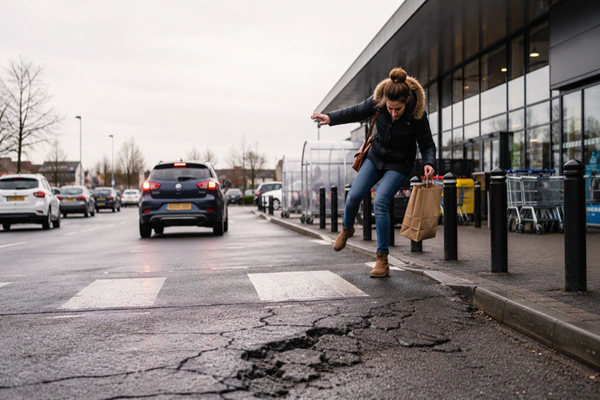
Not every pedestrian accident follows the same legal path. Two people can be injured in almost identical-looking locations, yet the responsibility for what happened can fall on completely different parties.
This is where confusion starts.
Many people assume that any trip on a pavement or hard surface is automatically the local council’s fault. In practice, this is one of the hardest types of claim to win. Highway authorities have a well-established statutory defence, and they use it often. Where a claim has a much stronger chance of success is when the accident happens on private land, such as a retail park, superstore car park, or supermarket forecourt.
Understanding this distinction is crucial in determining whether a claim succeeds or fails.
Why the focus shifts away from the public highway
Under Section 58 of the Highways Act 1980, a local council has a defence available to it if it can show it took reasonable care to ensure the relevant part of the highway was safe. In practice, this means demonstrating that it operated a reasonable system of inspection and maintenance. Because most councils now have well-documented inspection regimes, this defence succeeds in the majority of straightforward pavement trip claims.
Retail parks, superstores, and supermarkets are different. As occupiers of private land, businesses such as Asda owe visitors a duty of care under the Occupiers’ Liability Act 1957 to keep their premises reasonably safe. There is no equivalent statutory defence available to a private landowner in the way Section 58 protects a council. This does not make a claim automatic, but it does mean the legal footing is often more favourable to the injured person.
For this reason, this article focuses on supermarket and retail park slip and trip claims and on vehicle accidents that happen on that same private land, rather than on public highway pavement claims.
What counts as a private land trip vs. a vehicle accident?
A trip on private land typically involves a defect in a car park, walkway, or entrance area controlled by a retailer or landowner. This could include cracked tarmac, potholes in a car park, loose paving outside a store entrance, trolley bay hazards, or spillages left uncleared inside a supermarket.
There is no direct vehicle involvement. The injury happens because the environment the retailer controls is unsafe for visitors.
A vehicle-related accident, by contrast, involves direct impact or interaction with a vehicle. On private land, this most often happens in a car park, at a pedestrian crossing point within a retail park, or right outside a store entrance.
Where things become more complex is in situations where both elements are present. A defect in a car park surface may force a pedestrian into a vehicle’s path, or poor layout and visibility in a retail park may create a hazard for both pedestrians and drivers.
These are the cases where liability is often disputed.
The key legal difference: Who controlled the risk
The central question is not simply where the accident happened. It is who had control over the condition or behaviour that caused it.
Retailers and landowners are responsible for maintaining their premises, including car parks and walkways. Drivers are responsible for how they operate their vehicles, wherever they are driving. When an accident occurs, the focus shifts to which party failed in that responsibility. This is why two similar-looking incidents in the same retail park can lead to entirely different legal outcomes.
When retailers and landowners can be held responsible
Retailers, retail park operators, and other occupiers of private land have a duty to keep their premises reasonably safe for visitors. This duty is not absolute, but it is enforceable when clear failures occur.
They may be held responsible where there is evidence of:
- A defect in a car park or walkway surface that presents a genuine trip hazard
- Delays in repairing known issues within a reasonable timeframe
- Poor lighting in a car park or entrance area that contributes to unsafe conditions
- Trolleys, cages, or stock left obstructing a walkway or car park bay
- Spillages or drainage problems left unaddressed inside or outside the store
Unlike a council relying on Section 58, a retailer cannot point to a standalone statutory defence. It must instead show that its own maintenance and inspection systems were reasonable, and that it was not aware, and could not reasonably have been aware, of the hazard. This is generally a harder case for a business to make than it is for a highway authority.
This is where evidence becomes critical.
When the driver is responsible instead
In vehicle-related incidents on private land, responsibility usually sits with the driver, particularly where their actions directly caused the injury.
Common examples in a retail park or supermarket car park include:
- Reversing without properly checking for pedestrians
- Failing to give way at a car park crossing point or give way marking
- Mounting a kerb or pavement near a store entrance
- Travelling at inappropriate speeds for a busy car park environment
Even if the incident occurs on land owned or managed by a retailer, the presence of a vehicle does not automatically shift responsibility to the landowner. If the driver’s behaviour created the risk, liability remains with them.
Where cases become unclear
Some of the most complex claims sit in the space between these two categories.
For example, a pedestrian may trip over a damaged section of a car park surface and fall into the path of a moving vehicle. In another situation, poorly managed trolley bays or roadworks within a retail park may divert foot traffic into a live traffic lane, increasing the risk of a vehicle collision.
There are also shared-use areas, such as retail park approach roads, where pedestrians, cyclists, and vehicles occupy the same space. In these environments, responsibility can be harder to isolate.
These situations often lead to arguments around shared liability, where more than one party, the landowner and the driver, may have contributed to the conditions that caused the injury.
Scenario comparison: How liability shifts
Scenario A: A trip in a supermarket car park
A shopper walking through the car park of a large supermarket, such as Asda, trips on a raised or crumbling section of tarmac that has been in poor condition for an extended period. There is no vehicle involvement.
In this case, the focus is on whether the retailer knew, or should have known, about the defect and failed to repair it within a reasonable timeframe.
Scenario B: Vehicle impact in a retail park
A pedestrian walking along a designated footpath in a retail park is struck by a delivery van that reverses without checking its surroundings.
Here, responsibility sits with the driver. The car park surface itself is not the issue; the driver’s actions are.
Scenario C: Mixed fault
Poorly managed trolley storage blocks a section of footpath within a retail park, forcing pedestrians to step into the car park’s traffic route. A pedestrian is struck by a passing vehicle while doing so.
This situation may involve both the retailer responsible for the obstruction and the driver, depending on how the incident unfolded.
The process of proving liability in these claims
Establishing responsibility requires more than describing what happened. It involves demonstrating how the conditions leading to the accident were created and who had control over them.
Key forms of evidence often include:
- Photographs of the defect or scene at the time of the incident
- Maintenance and inspection records from the retailer or landowner
- CCTV footage, which is common across most supermarket and retail park car parks
- Witness accounts from staff or other shoppers
The strength of a claim depends on how clearly this evidence connects the injury to a failure in duty.
Where Marley Solicitors fits in
Cases involving trips and vehicle incidents on retail park and supermarket land are rarely straightforward. Responsibility is often disputed, particularly where a business’s insurers seek to limit exposure.
Marley Solicitors handle these types of slips, trips and falls claims, including claims arising in supermarkets and shops, as well as road traffic accident claims where a vehicle is involved. Rather than relying on assumptions, we assess the available evidence, identify the responsible party, and pursue the claim accordingly.
This is particularly important in mixed-fault scenarios, where the difference between a successful claim and a rejected one often comes down to how liability is framed, especially when both a landowner and a driver may share responsibility for the accident.
What to do after a trip or vehicle-related accident on private land
The immediate steps you take can significantly affect the clarity of the incident’s later assessment.
Report the accident to the store or retail park management so it is logged, and ask them to preserve any CCTV footage covering the area. Seek medical attention so there is a clear record of injury. Document the scene, including the surface, lighting, or any obstruction, while details are still accurate.
These actions are not about building a case on the spot but about preserving information that may later be needed.
Final perspective
The most significant mistake people make is assuming that any trip on a hard surface is a straightforward council claim.
Highway pavement claims are frequently defeated by a council’s Section 58 defence. Trips and vehicle accidents on private land, such as retail parks and supermarkets, do not carry that same statutory obstacle, and liability instead depends on who controlled the risk and whether they failed in that duty.
Getting that distinction right early on is what determines whether a claim is viable and whether it is directed at the correct party from the start. Contact Marley Solicitors for a free, no-obligation consultation.