

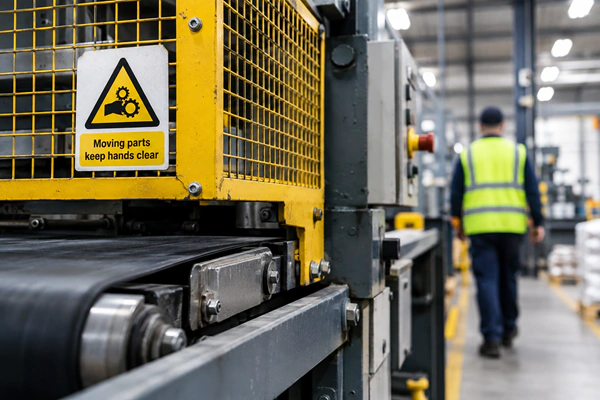
A moment of routine can turn into a life-changing injury on a factory floor. A jammed conveyor, a machine left running during a clearance task, a guard that was removed weeks ago and never put back. These are not rare, freak events. They are the pattern behind some of the most serious injuries reported in UK manufacturing every year, and in the majority of cases, they were preventable.
If you or someone in your family has suffered an amputation or crush injury while operating or working near machinery, this article explains where the legal responsibility sits, what the law actually requires of employers, and what you need to know before starting a claim.
Why machinery injuries happen
Manufacturing remains one of the higher-risk sectors in Great Britain. Contact with moving machinery, being struck by moving parts, and trapping or crushing incidents are consistently among the most common causes of serious injury reported to the Health and Safety Executive (HSE). These are not injuries caused by unlucky timing. They happen because a machine was not properly guarded, a safety interlock was bypassed, or a worker was never trained to isolate the equipment before reaching into it.
The financial and human cost is significant. HSE estimates put the total annual cost of workplace injury and ill health at close to £23 billion, and manufacturing continues to sit alongside construction and agriculture as one of the sectors with the highest rate of serious injury per worker employed.
What PUWER actually requires from employers
The Provision and Use of Work Equipment Regulations 1998, almost always shortened to PUWER, sets out the legal duties that apply to anyone who owns, controls or provides machinery for use at work. It applies to everything from hand tools to industrial presses and conveyor systems.
Regulation 11 is the part of PUWER that matters most in serious injury cases. It requires an employer to take effective measures either to prevent access to any dangerous part of a machine or to stop that part moving before a person can reach it. The regulation sets out a hierarchy that employers are legally required to follow, in this order:
- Fixed guards that require a tool to remove them
- Other guards or protection devices, such as interlocked guards that stop the machine when opened
- Protection appliances, jigs, or push sticks that keep hands away from the danger zone
- Information, instruction, training and supervision, but only as a last resort, and never as a substitute for physical guarding
This hierarchy exists because relying on a worker’s caution or training is the least reliable form of protection. A guard cannot be forgotten, rushed, or overridden under pressure in the way a person can. Where an employer has skipped straight to training and supervision without first considering physical guarding that alone can point to a breach of PUWER.
Employers are also required under Regulation 6 to inspect equipment at suitable intervals, separately from routine maintenance. A machine can be well maintained and still fail an inspection duty if there is no record of it having been checked specifically for safety.
Enforcement is not theoretical
HSE prosecutions under PUWER continue to happen regularly, and the penalties are not minor. In August 2026, a chemical manufacturer in Norfolk was fined £100,000 plus costs after an employee was injured removing a box from a running conveyor with no guard fitted to prevent access to the moving parts. The company had pleaded guilty to breaching Regulation 11.
Cases like this matter for two reasons. First, they confirm that “the machine had always been run this way” is not a defence. Second, an HSE investigation and any resulting prosecution runs alongside, and separately from, a civil compensation claim. A prosecution punishes the employer for breaking the law. A civil claim compensates the injured worker for what they have lost. You do not need to wait for the outcome of an HSE case before pursuing your own claim, although the findings of an HSE investigation can provide useful supporting evidence.
Amputation and crush injuries: Why the law treats them differently
Amputations and crush injuries to the head or torso sit on HSE’s list of “specified injuries” under separate reporting regulations, alongside fractures, permanent loss of sight and serious burns. This means an employer has a legal duty to notify HSE without delay when one of these injuries occurs. If your employer failed to report an amputation or crush injury, that failure can itself be used as evidence of poor safety management when a claim is investigated.
These injury types tend to carry consequences well beyond the initial hospital stay:
- Loss of a limb or digit often means retraining for a different type of work, home and vehicle adaptations, and ongoing prosthetic costs that can run for decades, since prosthetic limbs need regular replacement and adjustment.
- Crush injuries can cause internal damage that is not immediately obvious, including nerve damage, compartment syndrome, or organ injury requiring long-term monitoring.
- Both often bring a psychological impact that is easy to overlook in the early stages, particularly where the injury has changed someone’s ability to work in the trade they trained for.
A claim following an amputation or crush injury should reflect all of this, not just the immediate medical costs. This can include past and future loss of earnings, the cost of care and rehabilitation, home adaptations, prosthetics and their ongoing maintenance, and compensation for pain, suffering and loss of amenity. Where liability is accepted early, it is often possible to secure an interim payment so that rehabilitation and adapted equipment do not have to wait until the claim fully settles.
Who can be held responsible
Employer liability is the most common route in these claims, but it is not the only one. Depending on how the accident happened, responsibility can extend to:
- The machine manufacturer or supplier, if the equipment was defectively designed or supplied without adequate guarding
- A maintenance contractor, if a guard was removed for servicing and never correctly refitted
- A colleague, where their negligent act directly caused the injury, with the employer usually held vicariously liable
An employer will sometimes argue that the injured worker was partly to blame, for example by reaching past a guard or disabling an interlock. This does not automatically defeat a claim. If the guarding, training or supervision was inadequate in the first place, the employer generally cannot rely entirely on the worker’s own conduct to avoid responsibility, although it may affect the value of the claim.
What to do if you have been injured by factory machinery
Practical steps in the days after the accident can make a real difference to how strong your claim is later:
- Report the injury formally and ask for a copy of the accident book entry
- Note down which machine was involved, whether a guard was fitted, and whether it was working correctly
- Get contact details for anyone who witnessed the accident
- Keep any photographs taken at the scene, and hold on to any protective equipment or clothing worn at the time
- Attend all recommended medical appointments, as this record supports both your recovery and your claim
You generally have three years from the date of the accident to bring a claim for an injury at work, so it is worth acting sooner rather than later while evidence and witness memories are still fresh. For injuries of this severity, where long-term care, adapted housing or on-going medical treatment may be needed, it is also worth reading about how serious injury claims are handled differently from more straightforward cases, since the way a claim is valued and managed changes considerably once lifelong needs are involved.
How we can help
Machinery injuries are rarely straightforward to investigate. We often find these cases involve technical evidence about guarding standards, maintenance records and manufacturer specifications that need to be gathered quickly before it is lost or altered. We act on a no win no fee basis and will handle that side of the investigation so you can focus on recovery. Get in touch for a free consultation to discuss what happened and what your options are.