

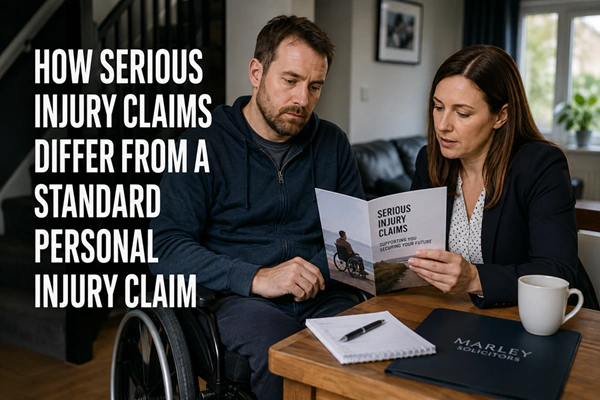
Two people can be hurt in accidents that were not their fault, yet end up with completely different claims. One person sprains a wrist, recovers in a few weeks and settles their case with little fuss. The other suffers a spinal cord injury and faces a lifetime of care, adaptation and lost income. Both are, technically, personal injury claims. In practice, almost everything about how those two claims are run is different.
If you or a member of your family has suffered a life-changing injury, it helps to understand why. The process, the evidence, the timescale and the way compensation is worked out all change once an injury crosses the line from ordinary to serious. Knowing what to expect makes a distressing situation a little easier to face, and it helps you spot when a claim is being handled with the care it deserves.
Where the line is drawn
A standard personal injury claim usually involves an injury that heals within a reasonable period. Think of whiplash after a minor collision, a broken bone that mends, or a soft-tissue strain following a slip. There is pain and disruption, but life returns to something close to normal.
A serious injury claim is different because the injury has a lasting or life-changing effect on a person’s health, independence or ability to earn a living. Brain and head injuries, spinal cord damage and paralysis, amputation, severe burns, loss of sight or hearing, and complex multiple fractures all sit in this category. These injuries can be caused in the same ways as any other, whether that is a road accident, a fall at work or medical negligence, but the consequences are on a different scale entirely. That single fact changes how the whole claim is approached.
The legal process runs on a different track
Lower-value claims are designed to be handled quickly and cheaply. In England and Wales, minor road traffic injuries are dealt with through a government portal, and many other modest claims follow a fixed-cost protocol with a set timetable. The system is deliberately streamlined, and for a straightforward injury that works well.
Serious injury claims cannot be squeezed into that framework. They are handled on what is known as the multi-track, where the court gives tailored directions and there is no fixed-cost shortcut. Each stage is managed individually, because the stakes and the complexity are far higher. This is one of the main reasons these cases are handled by specialist solicitors rather than treated as routine work.
The medical evidence is far more detailed
In an ordinary claim, a single report from one medical expert is often enough to describe the injury and confirm the likely recovery. That report values the claim and the matter moves towards settlement.
A serious injury demands a much fuller picture. Several experts are usually instructed across different fields, which may include a neurologist, an orthopaedic surgeon, a neuropsychologist, a care expert and an occupational therapist. Where an injury has caused lasting psychological harm, such as post-traumatic stress, that is assessed and valued in its own right rather than dismissed as a side effect. You can read more about how psychological injury is treated in a claim if that is relevant to your situation. The purpose of all this evidence is to understand not just what has happened, but what the injured person will need for the rest of their life.
Compensation looks decades into the future
The value of a standard claim is usually made up of the injury itself, a few months of lost earnings and the cost of any treatment. Once the person has recovered, the figure is reasonably easy to settle.
Serious injury compensation is built very differently. On top of an award for the injury and the pain it causes, a detailed schedule sets out future losses that can stretch across a whole lifetime. That can include ongoing professional care, case management, home adaptations or specially adapted accommodation, assistive technology, therapies, and lost earnings and pension. These future costs often dwarf the award for the injury itself, which is why they have to be calculated so carefully. Several factors affect the final figure in any claim, but in a serious case the margin for error is enormous. Marley Solicitors handle the full range of personal injury claims, and a specialist team knows how to build this kind of long-term valuation properly. If you want a sense of the sums involved, the serious injury claim calculator gives a useful starting point.
Money can be released before the claim ends
In a standard claim, you wait until the case concludes before you receive anything. That is rarely a problem when the injury is minor.
A serious injury often brings immediate financial pressure at the worst possible moment. Where the other side has admitted responsibility, it may be possible to secure interim payments, which are early instalments of compensation paid before the claim is finished. These can help cover treatment, care at home, equipment or lost income while the case continues. For a family suddenly coping with a life-changing injury, that early support can make a real difference.
Rehabilitation is part of the claim, not an afterthought
Recovery is usually left to the individual and the NHS in an ordinary claim, and the legal case simply follows along behind. Serious injury claims take a very different view. Under an agreed rehabilitation process, both sides can arrange and fund therapy and support early, before the claim is settled, so that the injured person has the best possible chance of recovery. Putting rehabilitation first, rather than treating it as something to sort out after the money arrives, is one of the clearest differences between the two types of claim.
The settlement can be structured for life
Most personal injury claims end with a single lump sum. That suits a case where the losses are known and finite.
With a life-changing injury there is a risk that a lump sum, however large, could run out if the person lives longer than expected or their needs grow. To guard against that, a serious injury settlement can include a periodical payment order. This provides guaranteed, index-linked payments every year for as long as they are needed, usually to cover care and lost earnings, alongside a lump sum for other losses. It is a level of financial protection that a standard claim never requires.
Someone else may need to bring the claim
An ordinary claim is almost always run by the injured person themselves. Serious injuries can remove that option. Where the injured person is a child, or an adult who lacks the mental capacity to manage their own affairs after a brain injury, a suitable person can act as their litigation friend and bring the claim on their behalf. In capacity cases, the court may also become involved to make sure any settlement is properly protected for the future.
Time limits work differently too. The usual rule gives three years to start a claim, but that clock does not run while someone lacks capacity, and for children it does not begin until their eighteenth birthday. The rules around claim deadlines are worth understanding early, because acting sooner always protects the evidence and strengthens the case.
It takes longer, and settling early can be a mistake
A minor claim might settle within months. A serious one commonly takes two to four years, and there is a good reason for that. Compensation can only be valued accurately once the long-term prognosis is reasonably clear. Settling before the full picture is known risks agreeing a figure that fails to cover a lifetime of need. In serious cases, patience is not delay for its own sake. It is what protects the injured person from being short-changed.
Why the right solicitor matters
The single biggest risk in a serious injury claim is that it is undervalued and settled for far less than the person will actually need. A firm that mainly handles routine claims may not have the experience, the expert contacts or the appetite for the long haul that these cases demand. A specialist team knows how to gather the right evidence, secure interim payments and rehabilitation, work with medical and care experts, and structure a settlement that lasts.
If you are dealing with a life-changing injury, either your own or that of someone you love, the most useful thing you can do is speak to a solicitor who handles this work every day. Marley Solicitors offer a free initial conversation, work on a No Win No Fee basis, and will give you an honest view of where you stand before you commit to anything.