

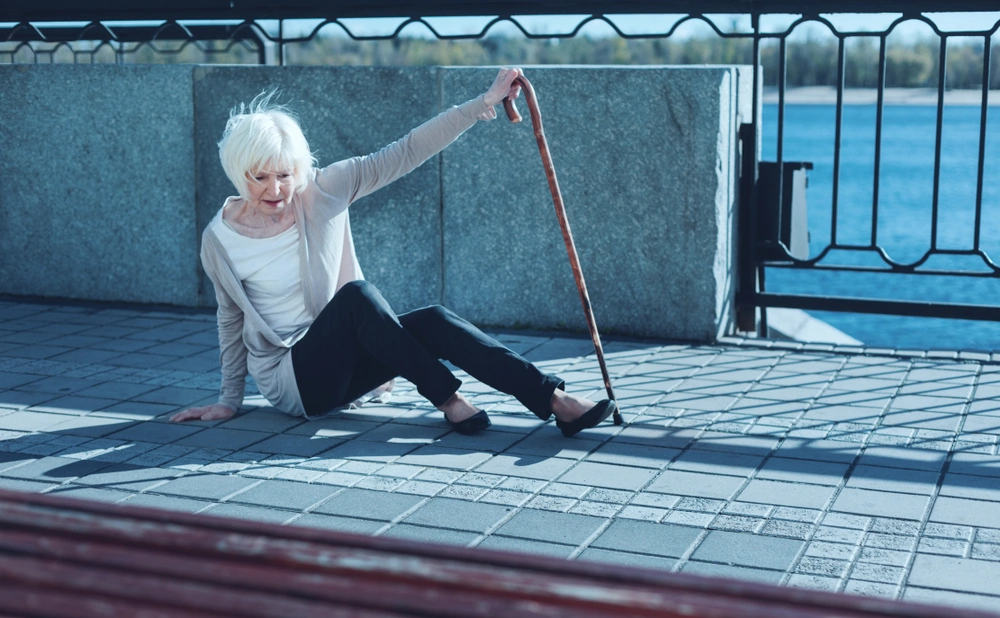
If you have been injured in a slip, trip or fall that was caused by someone else’s failure to keep a place reasonably safe, you may be entitled to compensation. Marley Solicitors acts for people across the UK in slip, trip and fall claims on a no win, no fee basis, whether the accident happened in a shop, on a pavement, at work or in any other public place.
Many people assume a fall is just bad luck, or feel embarrassed about it. But a wet floor with no warning sign, a broken paving slab or an unlit stairway is not bad luck, and the injuries that follow, often fractured wrists, ankles and hips, can mean weeks off work and months of recovery. We will tell you honestly in the first conversation whether we think a claim is likely to succeed.
 | Reviewed by Lesley Anne Delaney, Principal Solicitor and Director, Marley Solicitors Lesley was admitted as a solicitor in March 2008 and has practised in personal injury and clinical negligence litigation ever since. She is a Director and Owner of Marley Solicitors Ltd, and serves as the firm’s Compliance Officer for Legal Practice (COLP) and Compliance Officer for Finance and Administration (COFA). SRA ID 422379 | Verify on the Law Society register | Marley Solicitors Ltd is authorised and regulated by the SRA (No. 648368) | Last reviewed: October 2026 |
Can I claim for a slip, trip or fall?
You are likely to have a valid claim if all three of the following apply:
- the person or organisation in control of the place where you fell owed you a duty to keep it reasonably safe
- they failed to do so, for example by leaving a hazard in place, not warning of it, or not inspecting and repairing properly
- that failure caused your fall and your injury
The fact that you fell is not enough on its own. Accidents can happen even where everyone has taken reasonable care. What matters is whether the hazard should have been spotted and dealt with, and that is what we look at first.
Your injury needs to be more than trivial, but it does not need to be serious. If it needed medical treatment, kept you off work, or is still causing pain, it is worth a conversation.
Where slip, trip and fall accidents happen
- Supermarkets and shops – spillages, dropped produce, wet entrances and trailing cables
- Pavements and roads – broken or uneven paving slabs, potholes and missing kerbstones
- Restaurants, pubs and hotels – wet floors, poorly lit steps and loose carpets
- Car parks and shopping centres – uneven surfaces, ice and inadequate lighting
- Schools, play areas and leisure centres – damaged surfaces and wet changing rooms
- Public transport – stations, platforms and stairways
- Rented homes and communal areas – broken stairs, missing handrails and faulty lighting, which can also form part of a housing disrepair claim
- At work – which we handle as an accident at work claim
Where a fall has caused a life-changing injury, such as a serious head injury or complex fractures, our serious injury team works on the claim alongside rehabilitation and interim payments.
Slips, trips and falls – the current picture
Slips and trips are among the most common causes of injury in the UK. The Health and Safety Executive’s latest figures, for 2024/25, show that of the 59,219 non-fatal injuries to employees reported by employers:
- 30% were caused by slips, trips or falls on the same level, making it the single most common cause
- a further 8% were caused by falls from height
Those figures only cover workplace injuries that employers are legally required to report. Falls in shops, on pavements and in other public places are not counted, so the true number of people hurt each year is far higher.
Who is responsible for my fall?
Who you claim against depends on where you fell.
Shops, restaurants and other premises. Under the Occupiers’ Liability Act 1957, whoever controls a premises must take reasonable care to keep visitors reasonably safe. In practice that means having a system for checking floors, cleaning up spills promptly and warning of hazards. Where a shopper slips on a spillage, the courts have held that it is for the shop to show it had a reasonable system in place, rather than for the shopper to prove how long the spill had been there.
Pavements and roads. The local highway authority, usually the council, has a legal duty to maintain public highways under the Highways Act 1980. Councils can defend a claim by showing they had a reasonable system of inspection and repair, so these claims turn on the council’s inspection records, which we request on your behalf. There is no fixed minimum depth a defect must be. The question is whether it was dangerous to a reasonable pedestrian.
Snow and ice. Councils also have a duty to ensure, as far as reasonably practicable, that safe passage along a highway is not endangered by snow or ice. Businesses can be responsible for icy car parks and entrances on their own land.
At work. Your employer has duties under the Workplace (Health, Safety and Welfare) Regulations 1992 to keep floors and traffic routes in good condition and free from obstructions.
We identify the right party and their insurer for you. In almost every case the compensation is paid by an insurer, not by an individual.
What to do after a fall
The evidence that helps most is usually gathered in the first few days:
- photographs of the hazard, ideally with something for scale such as a coin or your foot, and of your injuries
- a note of exactly where you fell, the date and time, and what you were wearing on your feet
- names and contact details of any witnesses
- reporting the accident to the shop, business or employer, and asking for it to be recorded in their accident book
- asking for any CCTV to be kept, as it is often recorded over within days or weeks
- seeing your GP or going to A&E, so your injury is properly recorded
- keeping receipts for expenses and a note of time off work
For a pavement fall, it helps to report the defect to the council too, as their response can be useful evidence. Do not worry if you could not do all of this at the time. We can request CCTV, accident reports and inspection records on your behalf, and go back to the scene to photograph and measure the defect.
If you were partly to blame
You can still claim. If you were partly responsible, for example because you were looking at your phone or wearing unsuitable footwear, your compensation may be reduced to reflect your share of the responsibility. This is called contributory negligence, and it does not stop you recovering compensation for the other side’s share.
How much compensation could you receive?
Compensation is made up of two parts.
General damages cover the injury itself, including pain, suffering and the effect on your day-to-day life. These are assessed against the Judicial College Guidelines, which set brackets by injury type and severity and were updated in their 18th edition in April 2026.
Special damages cover your financial losses, both those already incurred and those expected in future:
- loss of earnings, including future loss if you cannot return to the same work
- physiotherapy and other treatment
- care and help at home, whether paid for or provided by family
- travel to medical appointments
- prescriptions, aids and equipment
- damaged belongings such as glasses, phones and clothing
Every case turns on its own facts. We value your claim using an independent medical report, so the figure reflects how long your symptoms are likely to last and not only how you feel today.
How to start a slip, trip or fall claim
- Free initial consultation. Tell us what happened. There is no cost and no obligation to go further.
- We assess the claim. We give you an honest view of whether it is likely to succeed, and say so plainly if we think it is not.
- We gather the evidence. Photographs, CCTV, accident reports and, for pavement falls, the council’s inspection and repair records.
- We notify the party responsible. We send the details of your claim to them or their insurer, who then has a set period under the court’s pre-action rules to investigate and respond on liability.
- Independent medical assessment. Arranged and paid for by us, to establish the extent of your injury and how long it is likely to last.
- Negotiation and settlement. Most claims resolve at this stage. Court proceedings are a last resort.
Where liability is admitted, we ask the insurer to fund treatment such as physiotherapy early, so you are not waiting for the claim to finish before you can start getting better.
How long does a slip, trip or fall claim take?
It depends mainly on whether the other side admits fault and on how quickly you recover. Straightforward claims where liability is accepted early often conclude within six months to a year. Claims against councils, or where liability is disputed, usually take longer, because the inspection records have to be obtained and examined.
We will not push you to settle before your prognosis is clear. Once a claim is settled it cannot be reopened.
Will I have to go to court?
Very unlikely. The great majority of slip, trip and fall claims settle through negotiation with the insurer. Issuing proceedings is sometimes necessary, usually to protect the time limit or where an insurer will not engage, and even then most cases settle before any hearing. If yours were one of the rare cases to reach a hearing, we would prepare you thoroughly and represent you throughout.
Time limits for making a claim
In most cases you have three years from the date of your fall to bring a claim.
There are exceptions:
- Children – the three years do not begin until their 18th birthday, so a claim can be brought up to their 21st
- People who lack mental capacity – no time limit runs while they lack capacity
- Accidents abroad – different and sometimes much shorter time limits can apply, see our accidents abroad page
Even where you have time, evidence fades quickly. CCTV is overwritten, defects get repaired and spills get cleaned up. The earlier you contact us, the stronger your claim is likely to be.
Claiming on behalf of someone else
For a child. A parent or guardian brings the claim as litigation friend. Any settlement has to be approved by a court, which exists to protect the child’s interests, and the money is usually held until they turn 18.
For an older relative. Falls can be especially serious for older people, and a hip fracture can mean a long recovery or a permanent loss of independence. If your relative lacks capacity to manage the claim themselves, a family member, deputy or attorney can act as litigation friend.
No win, no fee explained
We handle slip, trip and fall claims under a conditional fee agreement. If your claim does not succeed, you pay us nothing. If it succeeds, a success fee is deducted from your compensation, capped as a percentage of your damages. We set out the cap, and what it means for you in pounds, in writing before you sign anything.
Some claims need medical reports or court fees paid as the case runs. We explain how those costs are covered, including after the event insurance where it applies, at the outset rather than later.
Why choose Marley Solicitors?
- No win, no fee. No upfront cost, and nothing to pay if the claim does not succeed.
- An honest view early. We tell you if we think a claim will not succeed rather than running up costs on a case that is going nowhere.
- We do not dismiss smaller claims. A fall that other firms decline can still be worth pursuing, and we will tell you plainly whether yours is.
- One named person, start to finish. Your claim is handled by a named member of our team, under solicitor supervision, who you can contact directly.
- We come to you. If your injuries make travelling difficult, we can visit you at home or in hospital.
- Treatment first. Where liability is admitted, we push for rehabilitation to be funded early.
Real results

“I had an injury at a major Supermarket so I contacted several solicitors to make a claim for compensation. Most stated that the compensation I would receive would not be worth making a claim. Marley Solicitors stated the opposite and a claim was made. I was very surprised that I was offered more compensation than the claim put forward by Marley Solicitors … I would not hesitate to contact Marley Solicitors if I need there advice in the future.”
Peter | Supermarket accident claim
Slip, trip and fall claim FAQs
How serious does my injury need to be to claim?
It does not need to be serious, but it must be more than trivial. If your injury needed medical treatment, kept you off work, or is still causing pain or limiting what you can do, it is worth asking us. We will tell you honestly whether the likely compensation makes a claim worthwhile.
Is there a minimum depth for a pavement trip claim?
No. There is no legal minimum depth, and the often-quoted “one inch rule” is not a rule of law. The question is whether the defect was dangerous to a reasonable pedestrian, and whether the council had a reasonable system for inspecting and repairing the pavement. Many councils set their own repair thresholds, and we check the defect against those and against the council’s inspection records.
Can I claim if I slipped on a spillage in a supermarket?
Yes. Shops must have a reasonable system for checking floors and cleaning up spills. If you slip on a spillage, it is generally for the shop to show it had a proper system in place and followed it, rather than for you to prove how long the spill had been there.
Can I claim if I fell on ice or snow?
Possibly. Councils have a duty to ensure, as far as reasonably practicable, that safe passage along a highway is not endangered by snow or ice, and businesses can be responsible for icy car parks and entrances on their own land. These claims depend on what steps were reasonable in the conditions, such as gritting priority routes.
What if there were no witnesses?
You can still claim. Witnesses help, but they are not essential. Photographs of the hazard, CCTV, an accident book entry, your medical records and, for pavement falls, the council’s inspection records can all establish what happened.
I did not report the accident at the time. Can I still claim?
Yes, though it is best to report it as soon as you can. Many people do not report a fall straight away because they are embarrassed or do not realise they are hurt. Your medical records will show when and how you were injured, and we can still approach the business or council for their records.
Can I claim if I was partly to blame?
Yes. Your compensation may be reduced to reflect your share of the responsibility, for example if you were not looking where you were going, but you can still recover compensation for the other side’s share.
Will I have to deal with the shop or council myself?
No. Once you instruct us, we deal with the business, council or their insurer on your behalf. In almost every case the compensation is paid by an insurer.
What is the time limit for a slip, trip or fall claim?
In most cases you have three years from the date of the fall. For children, the three years do not start until their 18th birthday, and there is no time limit while someone lacks mental capacity.
Do you offer no win no fee slip, trip and fall claims?
Yes. We handle slip, trip and fall claims on a no win, no fee basis. There are no upfront legal fees, and if the claim does not succeed you owe us nothing.
Slip, trip and fall compensation calculator
A calculator gives you a rough indication only, and it cannot account for lost earnings, ongoing symptoms or the long-term effect of an injury. We will give you a more accurate assessment, free of charge, once we know more about your injuries.

Speak to a slip, trip and fall solicitor
Tell us what happened and we will tell you where you stand. The first conversation is free, there is no obligation, and we will give you an honest view rather than an encouraging one.
Call us: 01772 282600
Email: lesley@marleysolicitors.co.uk / yasmin@marleysolicitors.co.uk
Or complete our online enquiry form and we will call you back.
Sources
Health and Safety Executive, Kinds of accident statistics, 2024/25
Occupiers’ Liability Act 1957
Highways Act 1980, sections 41 and 58
Workplace (Health, Safety and Welfare) Regulations 1992
Limitation Act 1980
Ward v Tesco Stores Ltd [1976] 1 WLR 810 (spillages in shops)
Judicial College, Guidelines for the Assessment of General Damages in Personal Injury Cases, 18th edition (April 2026)
Page reviewed by Lesley Anne Delaney, Principal Solicitor and Director, Marley Solicitors – October 2026. Next review: when the Health and Safety Executive publishes its 2025/26 statistics.


