

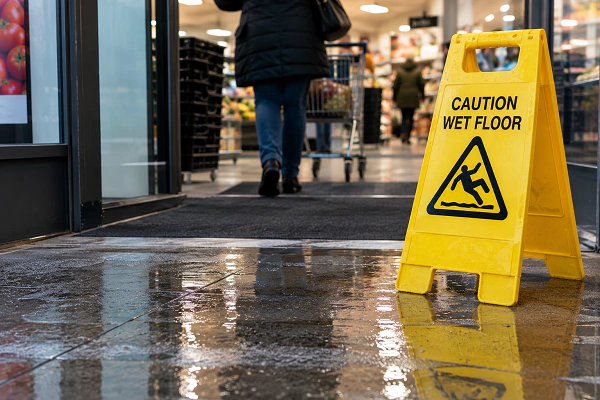
Rain, snow and ice can make everyday activities more hazardous, particularly when you are visiting a shop or supermarket. Water brought in on shoes, wet entrance tiles and slippery floors can turn a routine shopping trip into an accident that leaves you with painful injuries and unexpected expenses to cover.
However, slipping in bad weather does not automatically mean you have grounds to claim compensation. The important question is whether the shop or supermarket took reasonable steps to keep customers safe in the conditions.
If you have been injured after slipping in a shop during wet or icy weather, understanding the circumstances that may lead to a claim can help you decide what to do next.
Why does bad weather increase the risk of slips in shops?
Retail premises can become particularly hazardous during periods of heavy rain, snow or freezing temperatures. Customers regularly enter and leave buildings, bringing water, mud and other contaminants inside.
Some of the most common weather-related hazards include:
- Wet entrance floors: Rainwater can accumulate on tiles, vinyl and other hard surfaces, particularly near busy entrances.
- Saturated entrance mats: Mats can become soaked after prolonged rainfall, reducing their effectiveness at absorbing water and potentially creating additional hazards.
- Water tracked through aisles: Customers may carry water deeper into a shop on their shoes, leaving wet patches where other shoppers may not expect them.
- Snow and ice brought indoors: Slush from footwear can melt and spread across the floor, creating slippery patches.
- Icy external walkways: Paths and car parks can become hazardous when temperatures fall below freezing, particularly if ice is difficult to see.
- Inadequate warning signs: Customers may not realise a floor is slippery if there are no suitable warnings or if signs are positioned where they are difficult to notice.
The risk is not limited to supermarket entrances. Wet floors can develop around checkouts, customer service desks and other areas where people queue or move between sections.
Bad weather itself is not necessarily evidence of negligence. The issue is whether the responsible party took reasonable precautions against risks that could be anticipated in the circumstances.
Can you claim compensation for slipping in a shop during bad weather?
Potentially, yes. If a shop or supermarket failed to take reasonable care to keep its premises safe and that failure caused your injury, you may have grounds to pursue a personal injury claim.
Under the Occupiers’ Liability Act 1957, occupiers generally owe lawful visitors a duty to take reasonable care to ensure they are reasonably safe when using the premises for their permitted purpose.
During periods of bad weather, this may involve considering how water and ice are likely to affect the premises and what practical measures are reasonable to reduce the risk.
For example, a supermarket with a busy entrance during heavy rainfall may need to consider whether its floor inspections, cleaning arrangements and entrance mats are adequate for the conditions.
Factors that may be relevant include:
- How long the wet or slippery area had been present.
- Whether staff should reasonably have identified the hazard.
- Whether suitable floor mats or other precautions were in place.
- Whether inspections were carried out at appropriate intervals.
- Whether water was removed promptly after being identified.
- Whether warning signs were visible and adequate in the circumstances.
- Whether the flooring was suitable for the location and foreseeable conditions.
No single factor determines whether a claim will succeed. The available evidence and the circumstances of the accident must be considered together.
Marley Solicitors explains the wider legal principles in its guide to supermarket slip and fall compensation claims.
What should shops and supermarkets do when the weather turns bad?
Retailers cannot prevent rain or snow from falling, but they can take reasonable steps to manage the risks these conditions create inside and around their premises.
The precautions required will depend on factors such as the building layout, the type of flooring, the volume of customers and the severity of the weather.
Maintain suitable entrance mats
Entrance mats can help absorb water and reduce the amount carried into a building. However, they need to be appropriate for the location and maintained properly.
A mat that has become saturated, curled at the edges or moved out of position may create a hazard of its own. Simply having a mat near the entrance does not automatically mean the risk has been adequately managed.
Inspect floors more frequently when necessary
A floor that was dry during an earlier inspection may become slippery within minutes during heavy rainfall.
Reasonable inspection arrangements should take account of the conditions and the likelihood of hazards developing. If water is accumulating quickly at an entrance, a store may need to respond more frequently than it would during dry weather.
Clean up water and other contaminants
Where staff identify a slippery area, appropriate action should be taken within a reasonable time. This may involve removing the water, drying the affected surface or restricting access until the hazard has been addressed.
The time available to respond and the steps that could reasonably have been taken will be important when assessing responsibility.
Use appropriate warning signs
Warning signs can alert customers to wet floors, but they need to be positioned where people can see them and understand the risk.
A sign may be relevant when determining whether reasonable precautions were taken. However, the presence of a warning sign does not automatically remove an occupier’s responsibility in every situation.
Manage outdoor paths and car parks
Snow and ice can also create risks on access paths, pavements and car parks. The party responsible for maintaining the particular area may need to consider suitable precautions, depending on its control over the premises and the circumstances.
Responsibility for an outdoor accident is not always straightforward. The fact that a fall occurred outside a supermarket does not, by itself, establish that the supermarket was legally responsible.
What if you slip on rainwater that has been tracked into a shop?
One common scenario involves rainwater being carried inside by customers during a period of persistent rainfall.
Imagine entering a supermarket on a wet afternoon. The entrance tiles are visibly wet, several customers have already walked through the area, and there is a pool of water just beyond the doorway. You slip on the water and suffer a fractured wrist.
Whether you could claim compensation would depend on the evidence.
Questions might include whether the water had been accumulating for some time, whether staff had carried out reasonable inspections, whether suitable mats were in place and whether the store had a reasonable opportunity to address the hazard.
If another customer had only just brought water into the building moments before the accident, the supermarket might argue that it had insufficient time to identify and remove the hazard. That argument would need to be considered alongside the surrounding circumstances and any evidence of the store’s safety arrangements.
Equally, a store may face questions if repeated inspections were inadequate for the conditions or if staff had already been made aware of the problem.
The key point is that a wet floor does not automatically establish negligence, but bad weather does not automatically excuse a failure to take reasonable care either.
What should you do after a weather-related slip?
If you slip and injure yourself in a shop or supermarket, taking a few practical steps can help protect your health and preserve important evidence.
1. Seek medical attention
Your health should come first. Obtain appropriate medical advice and treatment, particularly if you have suffered a head injury, severe pain, difficulty walking or a suspected fracture.
Keep any medical records and information about treatment you receive.
2. Report the accident
Tell a member of staff or the store manager what happened and ask for the incident to be recorded.
Make a note of when and where the accident occurred and, if possible, the name of the person you spoke to.
3. Photograph the hazard
If it is safe to do so, photograph the wet floor, the entrance mats, any visible water accumulation and the surrounding area.
Try to capture the position of any warning signs and the condition of the floor. These details may help establish the circumstances in which the accident occurred.
4. Obtain witness details
If anyone saw the fall or noticed the wet floor beforehand, ask whether they would be willing to provide their contact details.
Witnesses may be able to explain how the accident happened or whether the hazard appeared to have been present for some time.
5. Ask for relevant CCTV footage to be preserved
CCTV may show the condition of the floor before the accident, how long the water was present and whether staff inspected the area.
Footage can be overwritten or deleted as part of routine retention procedures, so it is sensible to request its preservation promptly. A request does not guarantee that footage will be available or that you will automatically receive a copy.
6. Keep records of your expenses
If your injury affects your ability to work or carry out everyday activities, keep records of lost earnings and any related expenses.
These could include travel to medical appointments, medication costs or reasonable care and assistance needed during your recovery.
For more detail, read our guide to what evidence you need for a supermarket injury claim.
What if the shop says the weather was to blame?
A shop or supermarket may argue that rain, snow or ice was responsible for the accident rather than any failure on its part.
However, the weather alone does not settle the question of legal responsibility. The circumstances must be examined to establish whether reasonable precautions were taken and whether any failure caused the injury.
For example, a retailer might point to its inspection records or argue that a patch of water appeared shortly before the fall. Evidence such as CCTV, photographs, witness accounts and cleaning records may help clarify what happened.
A shop may also argue that warning signs were present or that the injured person contributed to the accident. If contributory negligence is established, compensation may be reduced to reflect the injured person’s share of responsibility. It does not necessarily prevent a claim altogether.
If a retailer or its insurer disputes liability, Marley Solicitors has further guidance on what happens if a supermarket denies responsibility.
What compensation could you claim?
If you have a valid personal injury claim, compensation may cover the impact of the injury and the financial losses caused by the accident.
Depending on your circumstances, this may include:
- Pain and suffering: Compensation reflecting the injury, its severity and its effect on your quality of life.
- Loss of earnings: Income lost because you were unable to work, where supported by evidence.
- Medical and rehabilitation costs: Reasonable expenses associated with treatment and recovery.
- Travel expenses: Costs incurred when attending medical appointments or rehabilitation.
- Care and assistance: Reasonable support required because your injury prevents you from carrying out everyday tasks independently.
The amount will depend on the nature of the injury, the recovery period, any lasting effects and the financial losses that can be established.
An accident does not automatically entitle you to compensation. You must be able to establish the relevant legal basis for the claim, including the connection between the alleged failure to take reasonable care and your injury.
How long do you have to make a claim?
In England and Wales, personal injury claims are generally subject to a three-year limitation period. This usually runs from the date of the accident, although exceptions apply in certain circumstances, including claims involving children and people who lack the mental capacity to conduct proceedings.
It is advisable to seek legal advice as soon as reasonably possible. Early action can help preserve CCTV footage, identify witnesses and obtain records that may become harder to access over time.
Speak to Marley Solicitors about a slip in bad weather
Slipping in a shop or supermarket during heavy rain, snow or icy conditions can cause more than temporary embarrassment. Serious falls may lead to fractures, head injuries and time away from work.
If you believe a shop or supermarket failed to take reasonable precautions against a foreseeable wet-floor hazard, Marley Solicitors can help you understand whether you may have grounds to claim compensation.
You can learn more about the firm’s slips, trips and falls claims service and the options available following an accident.
Contact Marley Solicitors to discuss your circumstances and find out what steps you could take next.