

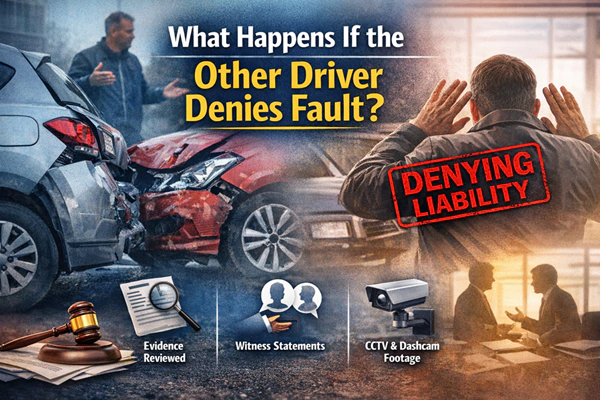
Being involved in a road traffic accident can be stressful even when responsibility appears clear. The situation can become more complicated if the other driver refuses to accept blame for what happened.
Many people assume that a claim cannot proceed if the other driver denies fault. In reality, liability disputes are relatively common in road traffic accident claims across the UK.
Understanding how these situations are investigated can help clarify what happens next and how solicitors work to establish responsibility.
Why do drivers sometimes deny responsibility?
There are many reasons why a driver might deny fault after an accident.
In some cases, the driver may genuinely believe they were not responsible. Accidents can happen quickly, and individuals may interpret events differently depending on their perspective.
In other situations, drivers may worry about the impact on their insurance record or potential increases in premiums. This can lead them to dispute liability even when the circumstances appear straightforward.
Occasionally, responsibility is genuinely unclear. Multiple vehicles may be involved, road conditions may have contributed to the collision, or both drivers may share some degree of responsibility.
For these reasons, liability is not always determined immediately after an accident.
How insurance companies investigate accidents
Once a claim is reported, insurers usually begin investigating the circumstances of the accident.
This process involves reviewing information from both drivers and examining any available evidence. Each insurer will attempt to determine how the collision occurred and whether their policyholder was responsible.
In this phase, insurers may share information and evaluate the possibility of resolving the claim without resorting to legal action.
The claim may move forward rather quickly if both insurers agree on who was at fault.
However, when responsibility is disputed, further investigation is often required.
Evidence used to determine liability
Establishing fault in a road traffic accident usually depends on the available evidence.
Many forms of evidence may be considered during the investigation.
Witness accounts can provide independent descriptions of what happened. These statements are particularly useful when they come from individuals who were not involved in the accident.
Photographs of the accident scene may also help explain the circumstances of the collision. Images showing vehicle damage, road markings, traffic signals, or road conditions can all help explain how the accident occurred.
Vehicle damage patterns may also be analysed. In some cases, the position and extent of the damage can help determine the direction and impact of the collision.
When available, dashcam or CCTV footage can be particularly persuasive. Video evidence may show exactly how the accident unfolded.
Together, these sources help insurers and solicitors build a clearer picture of the events leading to the accident.
Situations where liability may be shared
Not every accident leads to a single driver bearing full responsibility.
In some cases, investigators may conclude that both drivers contributed to the collision. This is sometimes referred to as split liability.
For example, one driver may have failed to check their mirrors before changing lanes while the other driver may have been travelling above the speed limit.
When this happens, compensation may still be available, but it may be reduced to reflect the claimant’s share of responsibility.
Determining whether liability should be shared often requires careful review of the evidence.
When the dispute continues
Sometimes insurers cannot agree on who was responsible for the accident. When this happens, the claim may take longer to resolve.
Solicitors may become involved in gathering additional evidence to strengthen the case. This could involve contacting witnesses, obtaining expert reports, or reviewing further documentation relating to the accident.
More complex cases may require accident reconstruction specialists to analyse the collision and offer an independent opinion on its cause.
Should negotiation fail to resolve the dispute, the legal process may initiate the claim.
The role of a personal injury solicitor in disputed claims
When liability is contested, a solicitor can help investigate the accident and present evidence supporting the claim.
This may include reviewing police reports, examining photographs from the scene, and analysing witness statements.
Solicitors may also communicate with insurers on behalf of the claimant to challenge liability decisions where necessary.
By organising the available evidence and presenting a clear account of events, a solicitor helps demonstrate how the accident occurred and why the other driver may be responsible.
Why early evidence can make a difference
Evidence collected soon after an accident can be particularly valuable.
Witnesses are more likely to remember events clearly in the immediate aftermath of a collision. Photographs taken at the scene may also capture details that later disappear once vehicles are moved or repairs are carried out.
In some cases, nearby CCTV cameras may have recorded the incident. However, such footage is often deleted after a short period unless requested.
Seeking legal advice early can therefore help ensure that relevant evidence is preserved.
Legal time limits for road traffic accident claims
In most road traffic accident cases in the UK, a personal injury claim must be started within three years of the accident or the date the injury became known.
Although this may appear to be a long period, liability disputes and evidence gathering can take time.
Beginning the process sooner allows solicitors to investigate the circumstances thoroughly while evidence remains available.
Moving forward when fault is denied
If the other driver denies responsibility, a claim can still succeed.
Liability disputes are a recognised part of many claims for road traffic accidents, and insurers and solicitors regularly investigate such situations.
By gathering evidence, analysing the circumstances of the accident, and presenting a clear account of events, it is often possible to establish responsibility even when a fault is initially disputed.
For individuals unsure how to proceed after an accident, seeking legal advice can help clarify whether a claim may still be possible and what steps should be taken next.